WE TALK ABOUT LOTUS TEMPLE

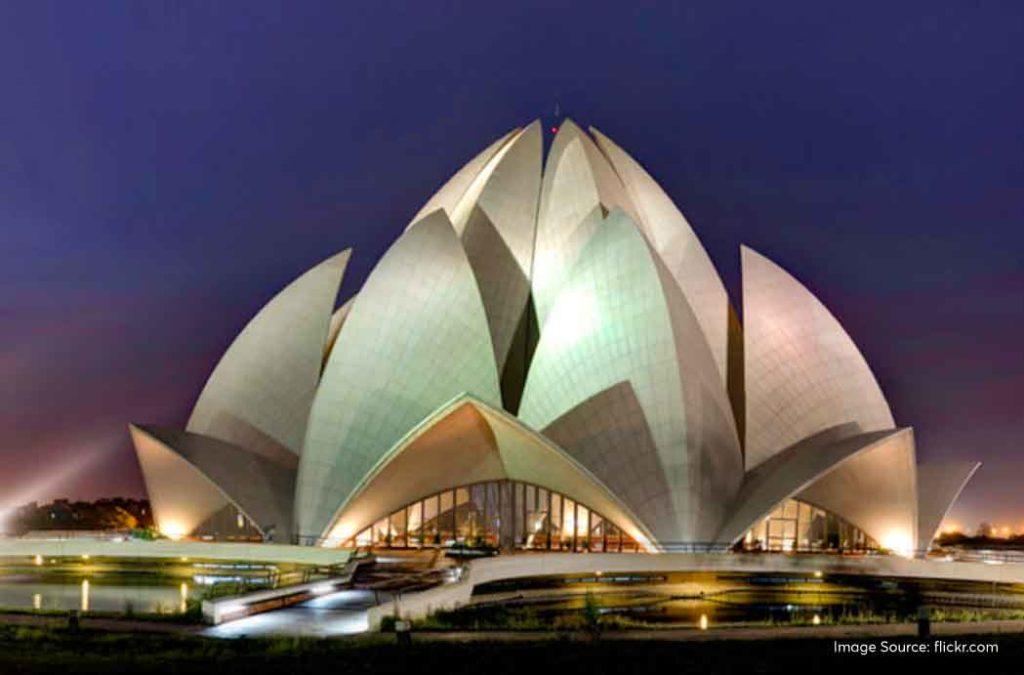
The Lotus Temple is a Bahá'í House of Worship in New Delhi, India. It was completed in December 1986. Notable for its lotus-like shape, it has become a prominent attraction in the city. Like all Bahá'í Houses of Worship, the Lotus Temple is open to all people, regardless of religion or any other qualification. The building is composed of 27 free-standing marble-clad "petals" arranged in clusters of three to form nine sides, with nine doors opening onto a central hall with a height of slightly over 34 metres and a capacity of 1,300 people. The Lotus Temple has won numerous architectural awards and has been featured in many newspaper and magazine articles.
The architect of the Lotus Temple was an Iranian, Fariborz Sahba, who now lives in La Jolla, California,[6] after spending some years in Canada.[7] He was approached in 1976 to design the Lotus Temple and later oversaw its construction. The structural design was undertaken by the British firm Flint and Neill over the course of 18 months,[8] and the construction was done by ECC Construction Group of Larsen & Toubro Limited[9][dead link] at a cost of $10.56 million.[10][11] The major part of the funds needed to buy this land was donated by Ardishír Rustampúr, of Hyderabad, Sindh (Pakistan), who will stipulated that his entire life savings would go towards the building of the temple.[12][page needed] A portion of the construction budget was saved and used to build a greenhouse to study indigenous plants and flowers that would be appropriate for use on the site.[13]
Rúhíyyih Khánum laid the foundation stone for the Lotus Temple on 19 October, 1977, and dedicated the temple on 24 December 1986.[14] For the dedication, there was a gathering of 8,000 Bahá'ís from 107 countries, including some 4,000 Bahá'ís from 22 states in India. The temple was opened to the public on 1 January 1987 and more than 10,000 people visited that day.[15]
Worship
The Bahá'í Faith states that a Bahá'í House of Worship should be a space for people of all religions to gather, reflect, and worship.[16] Anyone may enter the Lotus Temple irrespective of religious background, gender, or other distinctions, as is the case with all Bahá'í Houses of Worship.[16] The sacred writings of not only the Bahá'í Faith but also other religions can be read and/or chanted, regardless of language;[16] on the other hand, reading non-scriptural texts is forbidden, as is delivering sermons or lectures, or fundraising. Musical renditions of readings and prayers can be sung by choirs, but no musical instruments can be played inside. There is no set pattern for worship services, and ritualistic ceremonies are not permitted.[16]
Structure
Interior view
Interior view of the Ringstone Symbol, set at the top of the temple
All Bahá'í places of worship, including the Lotus Temple, share certain architectural elements, some of which are specified by Bahá'í scripture. `Abdu'l-Bahá, the son of the founder of the religion, wrote that Bahá'í Houses of Worship must be nine-sided and circular.[16] While all current Bahá'í Houses of Worship have a dome, this is not regarded as an essential part of their architecture.[14] The Bahá'í scripture also states that no pictures, statues or images may be displayed within the House of Worship, and no pulpits or altars may be incorporated as an architectural feature (readers may stand behind simple portable lecture stands).[16]
The design for the House of Worship in New Delhi is inspired by the lotus flower and is composed of 27 free-standing marble-clad "petals" arranged in clusters of three to form nine sides. The temple's shape has symbolic and inter-religious significance because the lotus is often associated with purity, sacredness, spirituality, and knowledge. It has a spiritual significance in India.[3] The nine doors of the Lotus Temple open onto a central hall, 34.3 meters tall[1] that can seat 1,300 people[18] and hold up to 2,500 people The temple has a diameter of 70 m. The surface of the House of Worship is made of white marble from Penteli mountain in Greece, the same marble used in the construction of many ancient monuments (including the Parthenon and other Bahá'í buildings.Along with its nine surrounding ponds and gardens, the Lotus Temple property comprises 26 acres (105,000 m2; 10.5 ha).[4] An educational center beside the temple was established in 2017.
The Lotus Temple is situated about 500 meters away from the Kalkaji Mandir metro station. It is in the village of Bahapur in New Delhi, National Capital Territory of Delhi, near Nehru Place and lies on the western bank of the Yamuna River.[24]
Of the temple's total electricity use of 500 kilowatts (kW), 120 kW is provided by solar power generated by solar panels on the building. This saves the temple ₹120,000 per month.It is the first temple in Delhi to use solar power.
As is the case with other stone monuments, such as the Taj Mahal,
mumbai escorts|| gurugram call girls|| gurugram escort service || gurugram call girls|| jaipur escorts|| call girls in gurugram||


Comments
Post a Comment